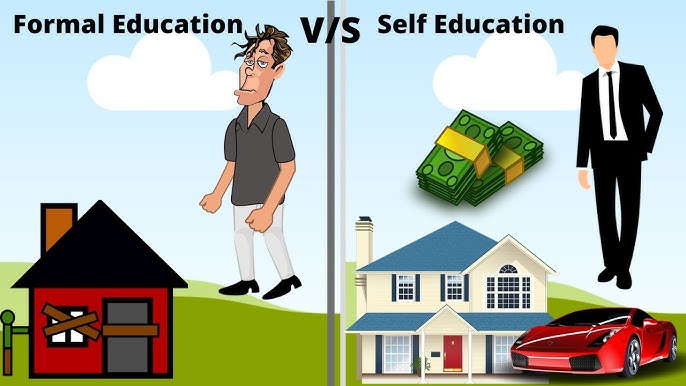
Emma had a good job and a college degree. On paper, everything looked fine. But after a few years, she started feeling stuck. New tools were coming into her field, new skills were being demanded, and she realized something important—what she learned in college was no longer enough.
At the same time, her younger cousin Jake was learning online. No formal degree yet, but he had already built websites, done freelance work, and was earning money.
Emma started wondering: What works better today—formal education or self-learning?
The answer is not as simple as choosing one over the other. The world has changed, and so has the way we learn.
The Strength of Formal Education in a Changing World
Formal education still plays an important role. Colleges and universities provide structure, guidance, and a strong foundation. When Emma went through college, she didn’t just learn subjects—she learned discipline, teamwork, and how to think critically.
Degrees are still valuable in many fields. If you want to become a doctor, lawyer, or engineer, formal education is necessary. These careers require deep knowledge, proper training, and recognized qualifications.
There is also a sense of credibility that comes with a degree. Employers often use it as a starting filter when hiring. It shows that you have completed a certain level of education and commitment.
Another benefit is the environment. Being around professors, classmates, and campus activities creates a learning atmosphere that is hard to replace. You get exposure to different ideas and perspectives.
But Emma also noticed the limitations. Formal education can be slow to adapt. By the time a course is updated, the industry may have already moved forward. It also requires a significant investment of time and money.
She realized that while her degree gave her a strong start, it was not enough to keep her growing in a fast-changing world.
The Rise of Self-Learning and Real-World Skills
Jake’s approach was very different. He didn’t wait for a structured program. He picked a skill, found resources online, and started learning immediately.
This is the biggest strength of self-learning—it is flexible and fast.
If a new tool or trend appears, you can start learning it the same day. You are not limited by a fixed syllabus. You can choose what to learn, how to learn, and when to learn.
Jake didn’t just watch videos. He built small projects, made mistakes, and improved step by step. Within months, he had practical skills that he could show to clients.
Self-learning also allows you to focus on what actually matters in the job market. Instead of studying everything, you learn what is useful right now.
Another advantage is cost. Many high-quality resources are available online at low cost or even free. This makes learning accessible to more people.
But self-learning also has challenges. It requires discipline and consistency. There is no fixed schedule, no exams, and no one forcing you to continue. Many people start but don’t finish.
Emma tried self-learning at first and found it difficult. Without structure, she felt lost. But once she created a routine and clear goals, it became easier.
She realized that self-learning is powerful, but only if you stay committed.
Finding the Right Balance for Today’s World
Over time, Emma stopped thinking of it as a competition between formal education and self-learning. Instead, she started combining both.
Her degree gave her a strong base. Self-learning helped her stay updated.
She began taking short online courses related to her job. She applied new skills at work, experimented with tools, and slowly became more confident. Within a year, she noticed real growth—not just in knowledge, but also in opportunities.
This is how learning works today. It is not one or the other. It is a continuous process.
Employers are also changing how they evaluate people. They still value degrees, but they also look at skills, projects, and real-world experience. What you can do is becoming just as important as what you studied.
Jake, on the other hand, eventually considered formal education too. Not because he needed it immediately, but because he saw value in structured learning and networking.
Both Emma and Jake realized the same thing from different paths. Learning does not stop after college, and it does not only happen online.
In today’s world, the question is not whether self-learning is better than formal education. The real question is how you use both to your advantage.
Formal education can give you a strong starting point. Self-learning helps you grow, adapt, and stay relevant.
If you depend only on a degree, you may fall behind. If you rely only on self-learning without direction, you may feel lost.
But when you combine structure with flexibility, and theory with practice, you create a powerful way to learn.
And that is what truly works today—not choosing one path, but building your own.